
Introduction
Your applicant tracking system gained a matching score last year. A sourcing tool ranks profiles. A job-board campaign targets an audience. None of that felt like deploying a high-risk AI system at the time, and all of it is named in the EU AI Act, in the text of Annex III rather than by implication.
This checklist is for the employer, because that is where the duties land. The vendor that built the model has obligations of its own, but the ones in this article follow the organisation that puts the system to use, and they do not transfer with a procurement contract. It covers what the Act names, what the July 2026 deferral did and did not change, the eight items worth having on file, and the two duties that were never deferred at all.
TL;DR
- Recruitment is named explicitly. Annex III point 4(a) covers AI "intended to be used for the recruitment or selection of natural persons, in particular to place targeted job advertisements, to analyse and filter job applications, and to evaluate candidates" (EU Artificial Intelligence Act, Annex III, Aug 2026).
- The deadline moved. Regulation (EU) 2026/1744 entered into force on 27 July 2026 and deferred the main obligations for standalone Annex III systems to 2 December 2027 (Hunton, Aug 2026).
- Transparency did not move. Article 50 duties applied from 2 August 2026, and they cover telling people they are interacting with an AI system.
- Deployer duties are specific: human oversight by people with "the necessary competence, training and authority", monitoring in operation, representative input data, and logs kept for at least six months (EU Artificial Intelligence Act, Art. 26, Aug 2026).
- One duty commonly listed does not apply to you. The fundamental rights impact assessment under Article 27 falls on public bodies and private entities providing public services, not on an ordinary employer hiring for itself.
- GDPR did not wait for any of this. Article 22 already restricts decisions based solely on automated processing, and it has applied since 2018 (EU GDPR, Art. 22, Aug 2026).
What does the Act actually name?
Recruitment, in the operative text rather than in a recital. Annex III point 4(a) reads:
"AI systems intended to be used for the recruitment or selection of natural persons, in particular to place targeted job advertisements, to analyse and filter job applications, and to evaluate candidates"
EU Artificial Intelligence Act, Annex III, August 2026
Three activities, and most stacks do all three without anyone calling it AI. Targeted job advertising is a campaign setting. Filtering applications is a knock-out question or a ranking. Evaluating candidates is a matching score or an assessment result.
This is why the useful first step is an inventory rather than a policy. Go through what is already connected and ask, per tool, whether it places, filters or evaluates. LinkedIn's Apply Connect, for instance, returns real-time applications together with skills-match data (LinkedIn Talent Solutions, Feb 2026). SmartRecruiters documents an assessment ordering flow where a partner returns a result and score against an order identifier (SmartRecruiters Developers, Aug 2026). Neither is marketed as high-risk AI. Both produce an output that ranks a person.
What in a normal recruiting stack is actually in scope?
More than the tools with AI in the name, and you can identify them from vendor documentation rather than from guesswork. Take the three Annex III verbs one at a time.
Placing targeted job advertisements. Any campaign that selects an audience rather than publishing to everyone. This is the one most often missed, because it sits with whoever runs paid channels rather than with recruiting operations.
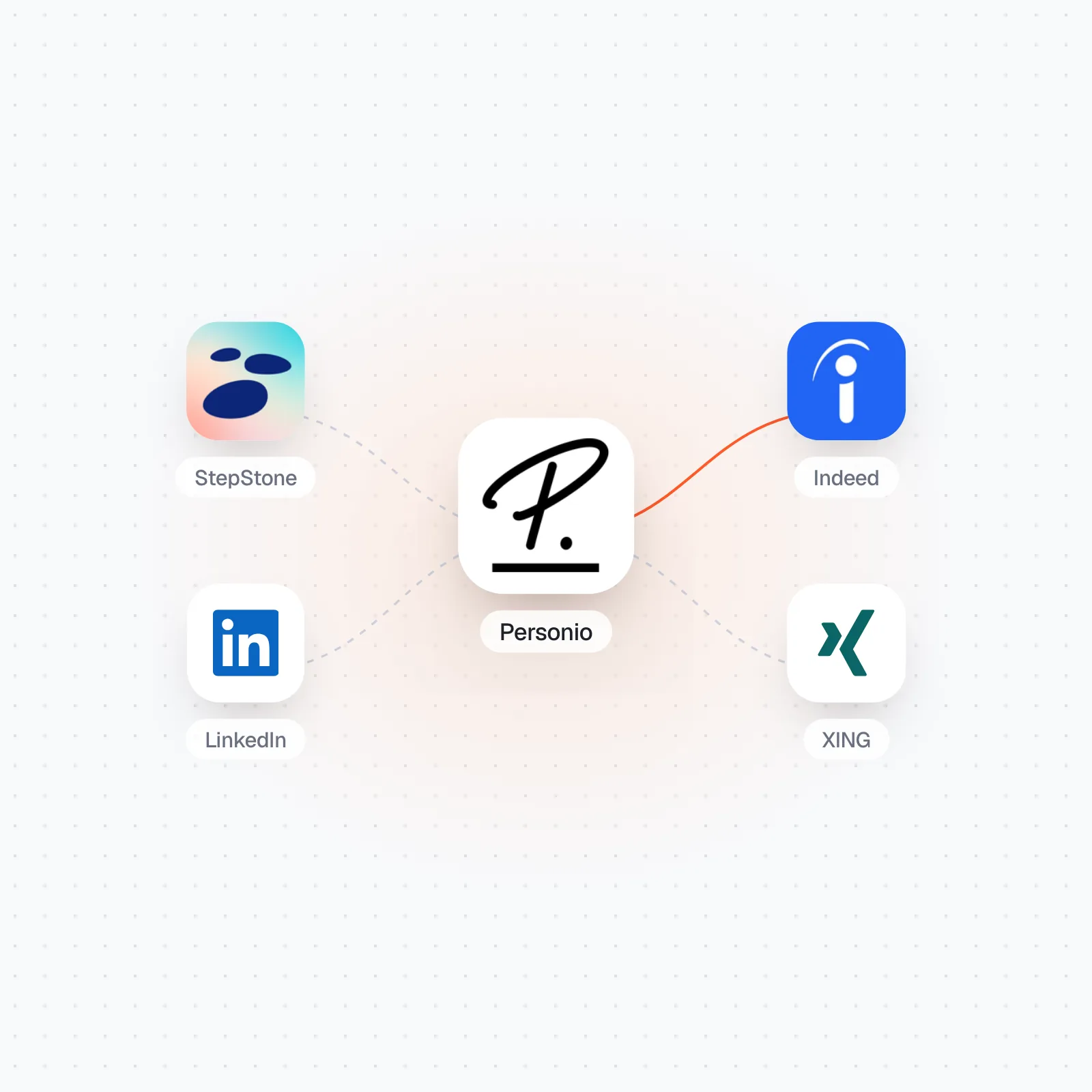
Analysing and filtering job applications. Screening questions with automatic knock-outs are the common case, and the structures involved are richer than teams assume. Indeed supports eleven screener question types including conditional and hierarchical logic (Indeed Partner Docs, Aug 2026), and StepStone supports branching questions (StepStone API knowledge base, Aug 2026). A branching question that ends in an automatic rejection is a filter, whatever the vendor calls it.
Evaluating candidates. Matching scores, assessment results, ranking. LinkedIn's Apply Connect returns skills-match data alongside the application (LinkedIn Talent Solutions, Feb 2026), and SmartRecruiters documents assessment results returned against an order identifier (SmartRecruiters Developers, Aug 2026).
Where those outputs land matters for the documentation as much as for the workflow. Personio accepts applications through a Recruiting API whose token is predefined per account (Personio Developer Hub, Aug 2026); a score that arrives as an attachment rather than a field cannot be reviewed, compared or audited later, which makes both the oversight duty and the monitoring duty harder to discharge than they need to be.
What did the July 2026 deferral change?
The date, and not much else. It is worth being precise, because the change is easy to over-read in both directions.
Regulation (EU) 2026/1744, the Digital Omnibus, entered into force on 27 July 2026. It deferred the main obligations for standalone Annex III high-risk systems, the category employment sits in, to 2 December 2027. Embedded Annex I systems move to 2 August 2028. Transparency obligations were not deferred and applied from 2 August 2026 (Hunton, Aug 2026).
| Obligation | Applies from | Deferred in July 2026? |
|---|---|---|
| Prohibited practices | 2 February 2025 | No |
| Governance and general-purpose AI | 2 August 2025 | No |
| Article 50 transparency | 2 August 2026 | No |
| Annex III high-risk, standalone, including employment | 2 December 2027 | Yes, from 2 August 2026 |
| Annex I high-risk, embedded in regulated products | 2 August 2028 | Yes |
One practical warning, because it cost us a day. Several widely cited summaries of the Act still show the pre-amendment dates. One heavily referenced site is stamped "last updated 1 August 2024" on its implementation-timeline page and still shows the superseded date on its Article 26 page, while a third page on the same domain carries the current one. Check the currency of any source you rely on for a date here, not only its authority.
What does the Act ask of you as deployer?
Named, specific things, and the wording matters because it decides who in your organisation has to be involved. Article 26 requires:
"Deployers shall assign human oversight to natural persons who have the necessary competence, training and authority, as well as the necessary support."
EU Artificial Intelligence Act, Article 26, August 2026
The same article requires monitoring the system in operation against its instructions for use and informing the provider where relevant, ensuring input data is relevant and sufficiently representative for the intended purpose, keeping system-generated logs for at least six months, and reporting serious incidents. There is also a workplace-specific step that has to happen before anything goes live:
"Before putting into service or using a high-risk AI system at the workplace, deployers who are employers shall inform workers' representatives and the affected workers that they will be subject to the use of the high-risk AI system."
EU Artificial Intelligence Act, Article 26, August 2026
Read that against a German works council and it stops looking like a communications task appended to a launch. It is a precondition.
with your stack?


Which duty on most checklists does not apply to you?
The fundamental rights impact assessment. It appears on nearly every AI Act checklist aimed at employers, and for an ordinary private employer hiring for itself, Article 27 does not require one.
Article 27 places the obligation on deployers that are bodies governed by public law, or private entities providing public services, and on deployers of the systems in Annex III points 5(b) and 5(c), meaning creditworthiness and life or health insurance pricing. Employment is point 4. The assessment itself covers the deployer's processes, the period and frequency of use, the categories of people affected, the specific risks of harm, human oversight measures, and what happens if a risk materialises (EU Artificial Intelligence Act, Art. 27, Aug 2026).
Two qualifications before anyone deletes the work item. If you are a public-sector employer or provide public services, it does apply. And the content of a fundamental rights impact assessment is a reasonable structure for the risk documentation Article 26 does require, so the work is rarely wasted. What differs is the legal obligation, not the usefulness.
What was never deferred, and never depended on the Act?
Two things, and both apply to recruiting today.
Article 50 transparency. Where a system interacts with people, they have to be told, "unless this is obvious from the point of view of a natural person who is reasonably well-informed, observant and circumspect", and the information has to arrive "in a clear and distinguishable manner at the latest at the time of the first interaction or exposure" (EU Artificial Intelligence Act, Art. 50, Aug 2026). A conversational apply flow or a screening chatbot is squarely in scope, and this date did not move.
GDPR Article 22, which has applied since 2018 and is stricter than most recruiting teams assume:
"The data subject shall have the right not to be subject to a decision based solely on automated processing, including profiling, which produces legal effects concerning him or her or similarly significantly affects him or her."
EU GDPR, Article 22, August 2026
An automatic rejection on a knock-out question is a decision based solely on automated processing. The exceptions are narrow: contractual necessity, authorisation in law, or explicit consent. Where one of them applies, the controller must still provide a route to human intervention, a chance for the candidate to express a view, and the ability to contest the decision. Erasure duties run alongside: Article 17 requires the controller to erase without undue delay on any of six grounds (EU GDPR, Art. 17, Aug 2026).
Where does the documentation actually come from?
Mostly from the integration. Doing it while a connection is being built costs a fraction of reconstructing it later.
Three of the eight items below are produced as a by-product of connecting a system properly. The inventory falls out of listing what is connected. The log retention is a property of whatever moves the data. A connection that does not record what was sent and what came back cannot produce six months of logs after the fact. The representative-input-data statement describes what actually crosses the boundary, and a field mapping already requires that document.
The remaining five are organisational: naming the oversight person, writing down their authority, informing workers' representatives, drafting candidate-facing disclosure, and defining the human-review route. None of those needs a vendor, and none of them gets easier by waiting. The deferral to December 2027 is time to do this deliberately rather than time to postpone starting.
The checklist
Eight items. Most are documentation you can produce this quarter, and every one of them is easier to write while a system is being connected than to reconstruct afterwards.
| # | Item | Where it comes from |
|---|---|---|
| 1 | An inventory of every tool that places, filters or evaluates, including features inside your ATS | Annex III 4(a) |
| 2 | A named person exercising oversight, with their competence and authority written down | Article 26 |
| 3 | A monitoring routine, and a record of what you did with what it showed | Article 26 |
| 4 | A statement that input data is relevant and representative for how you use the system | Article 26 |
| 5 | Logs retained for at least six months | Article 26 |
| 6 | Evidence that workers' representatives were informed before use | Article 26 |
| 7 | Candidate-facing disclosure wherever a system interacts with them | Article 50 |
| 8 | A human-review route wherever a decision is effectively automatic | GDPR Article 22 |
Start with item 1, which is also the item people skip because it feels administrative. Every other item is impossible to complete without it, and it is the one most likely to surprise you. The AI in a recruiting stack usually sits inside tools bought for other reasons.
Where a connection moves candidate data between systems, the documentation and the integration are the same project. A connection you can describe is a compliance artefact as much as a technical one: what crosses, on what trigger, held for how long. A candidate record that stays current is the same document from the other side, and what comes back afterwards is what makes monitoring possible rather than theoretical.
What to do next
Three steps, in order:
- Inventory before policy. List every tool touching candidates and mark each one places, filters, evaluates, or none. An hour with the list of what is connected gets you further than a week of drafting.
- Name the oversight person now. Not a team, a person, with the authority to override an output. Article 26 asks for competence and authority together, and the second is the one that is usually missing.
- Check your dates against a current source. Several widely cited AI Act summaries still show the pre-July-2026 timeline. Confirm the date before you plan around it.
If you would like a second pair of eyes on which of your connected tools fall inside Annex III, a conversation with our team is a reasonable place to start. For the legal position itself, ask counsel rather than a vendor.